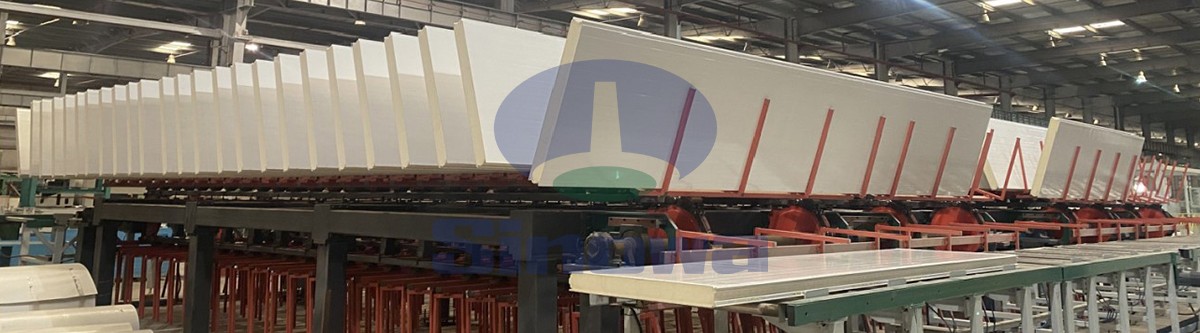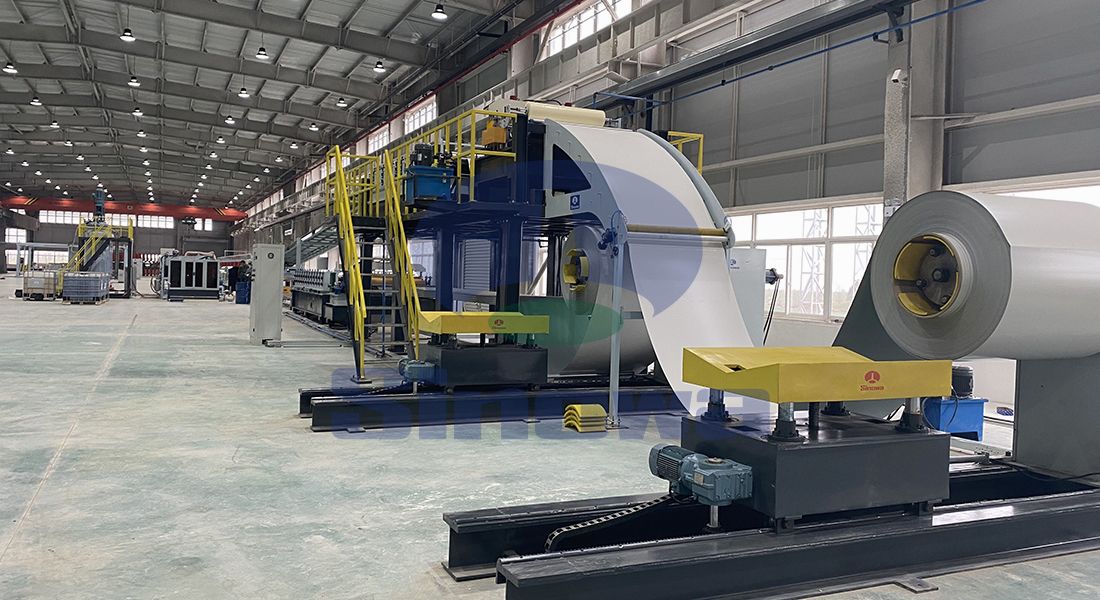
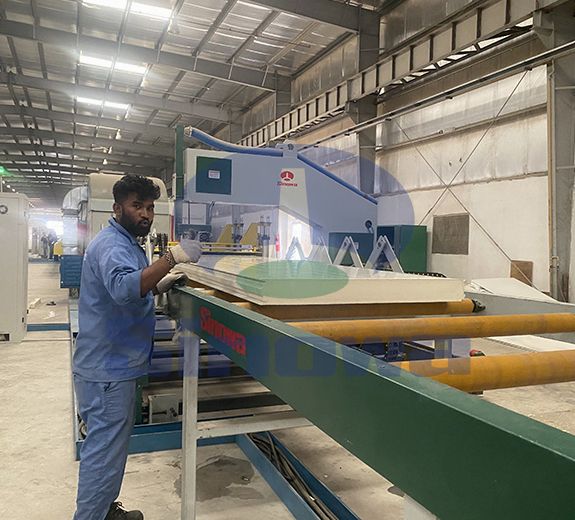
必威betway西汉姆 is a well-known PU Sandwich Panel Production Line Supplier From China, Dedicated to the research and development of high-end & high-efficiency pu sandwich panel production line, 必威betway西汉姆 is comprehensively taking the leading position in terms of efficiency, automation control level, HMI, environment protection and energy consumption, with subversive designs made in some critical technological fields to procure exceptional cost performance and customer-friendly experience for the entire pu sandwich panel production line.
The adoption of system integration technology and bus control technology accomplishes the full automatization of integrated and coordinated control of the entire pu sandwich panel production line with accessible remote interactive communication. Ranking the first-class level in the world, it is currently the continuous pu sandwich panel line in the market taking a comprehensive lead in high performance.
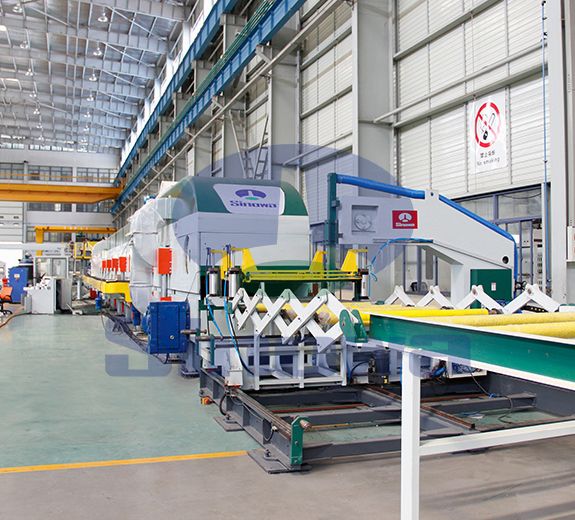
Based on the continuous technological pursuit, the pu sandwich panel production line developed by 必威betway西汉姆 provides you with high-efficiency industrial value. Based on China's cost advantage and our hard-working technology concept, our sandwich panel production line has a world-leading price-performance advantage. PU Sandwich Panel Production Line can meet a variety of production needs of customers.The whole sandwich panel line design concept of modularization enables all our components to be integrated and combined at will.
Our pu sandwich panel production line can easily automate the production of roof sandwich panel, wall sandwich panel, cold storage sandwich panel and other products by different combination and configuration selection and siple switching. The inner core layer can be polyrethane or rock wool, glass wool, an so on.
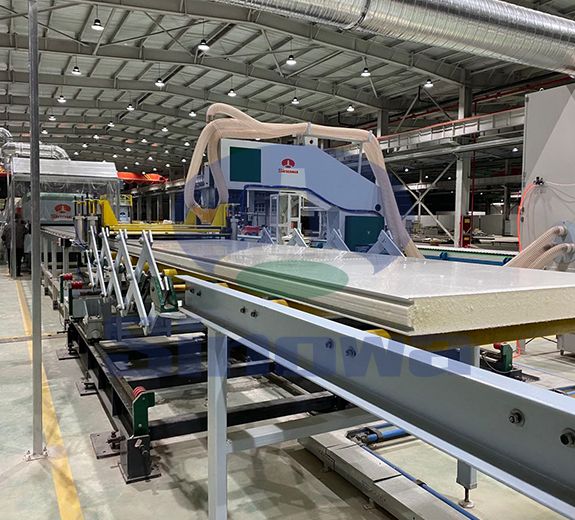
The pu sandwich panel production line has high adaptability, which may produce various sandwich panel of the PU, PIR and rock wool systems.
We may design various products according to the customer’s requirements, including various configurations, so as to meet their demands with flexible price system.
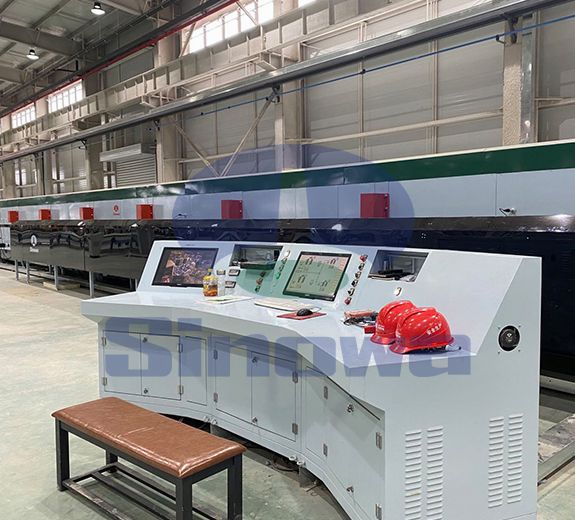
Highly integrated and linked control system centralizes all control points at the main central center, achieving parameter linkage, fault self-diagnosis controlled by the whole continuous sandwich panel line and shipping distance control.
High-level automatic control system also saves the manpower and reduces the manpower loss for customers.
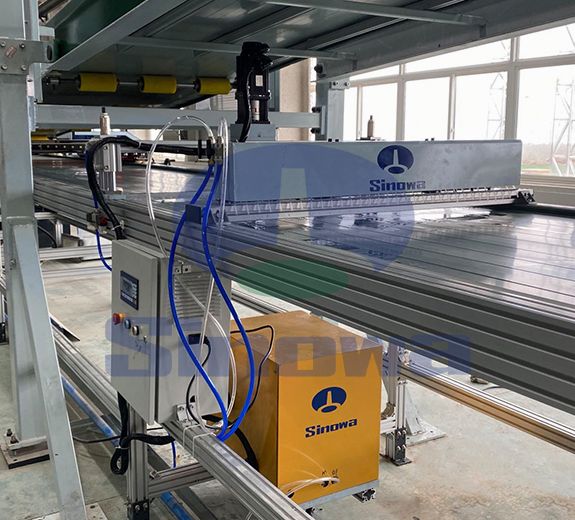
Concentrated system control is fully realized in the practice of concentrated process control so that the control system of all the movements of the parts in the pu sandwich panel production line is integrated in one process control console with accessible remote communication to elevate the automation and reduce the allocated number of personnel for the assembly line.
The main engine with modularized design achieves the precision operation of the pu sandwich panel production line, stable and reliable quality, less part and maintenance loss.
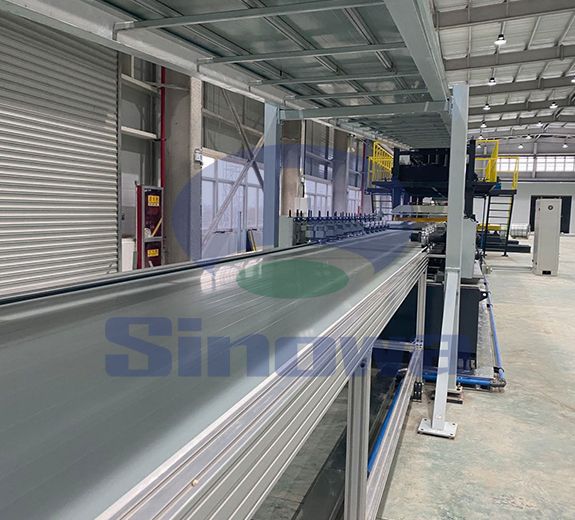
The whole pu sandwich panel production line is strictly modularized in design to ensure the greatest probability for the parts to be interchangeable, making it the most cost- and energy-saving. No joining made manually, all the key processes of the parts are completed in the machining center. As soon as the parts are inspected and warehoused, they enter into the assembly process. The modularized assembly can not only greatly increase the production efficiency but, most importantly, realize quick delivery as well. It elevates the reliability of product quality to a totally new level and minimizes the influence from human factors.
The whole pu sandwich panel production line has over 40 innovative inventions, making our products have lots of unique features and the comprehensive performance of our production line leading in the industry.
The precision servo hoisting mechanism employed by the main engine without hydraulic system makes the board thickness control flexible and the customer may conveniently change or adjust the board thickness. There will be not such troubles as hydraulic system adjustment, leakage, maintenance, etc.
High-level energy saving and protection design makes the whole pu sandwich panel production line possible to produce around the clock throughout the year and the customer will save huge budget. In addition, the isolated heat preservation room is constructed for warming the environment. The energy saving and protection design of our high-tech pu sandwich panel production line may guarantee that the customer’s production line may be freely heated and produce in the main time to save more costs for customers.
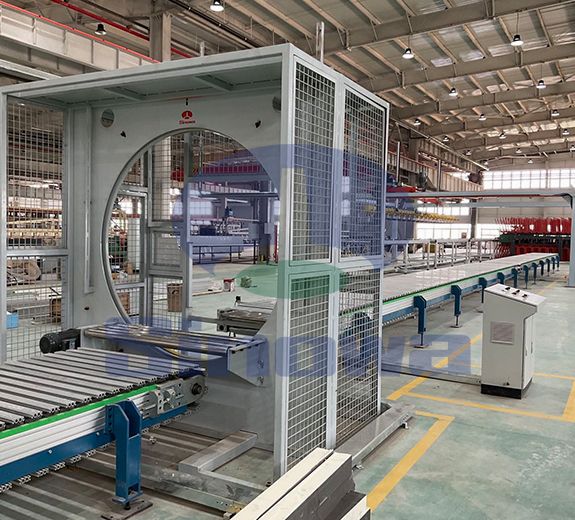
The high-power low-consumption design quickens the reaction of the pu sandwich panel production line while energy consumption is kept low.
With the brand-new, fully sealed inner insulation design, the energy consumption is controlled at the minimum level to achieve the design objective of less than an hour for the insulation system to be activated from the room temperature above 5℃ to the production process temperature.
The energy consumption is only 40% that of those similar products.
| PRODUCTION TYPE | PU | PIR | PHENOLIC | |||
|---|---|---|---|---|---|---|
| PRODUCTION USE | INSULATION PANEL | DOCORATIVE PANEL | ||||
| SURFACE OF SHEET | ALUMINUM FOIL | NON-WOVEN FABRIC | PAPER | NAKED | ||
| PRODUCT THICKNESS | 10m--- 200mm | |||||
| PRODUCTION SPEED | 3.0m---25m |
|---|---|
| FOAMING METHOD | TWO OR MULTI COMPONENTS FOAMING |
| FOAMING AGENT | PENTANE OR 141B |
| LENGTH OF LINE | 45m—100m CUSTOMER OPTIONAL |
必威betway西汉姆 is a well-known manufacturer and technical service provider of high-end polyurethane insulation board production lines and various high-performance cold roll forming machine in China. Our main products include polyurethane double-sided color steel sandwich panel production line, polyurethane and phenolic soft facing insulation panel production line and high-efficiency roll forming machines.
必威betway西汉姆 has invested outstanding efforts in both the insulation board production line and the roll forming line, This is why our products are more efficiency, quality, automatic control technology, environmental protection, energy consumption indicators and the appearance and safety protection are comprehensively leading, Some subversive design changes in many major technical points,these major innovations make our products excellent in price/performance and user experience.
必威betway西汉姆 is committed to the development and manufacturing of high-end and high-efficiency sandwich panel production lines. Our sandwich panel production lines are leading the way in efficiency, automatic control, human-computer interaction, environmental protection and energy consumption. Using system integration and bus control technology, it realizes the automatic integrated linkage control of the entire production line, and can achieve remote interactive communication, which has the world-class level and a comprehensive leading high-performance production line in the market.
The production of PU sandwich panels relies on a sophisticated combination of raw materials, each of which plays an irreplaceable role in determining the structural stability, physical performance and service durability of finished panels. In continuous production lines dedicated to PU sandwich panel manufacturing, material selection, proportioning control and raw material pretreatment constitute the core foundation of the entire production process. Every type of raw material involved in the production flow needs to match the processing characteristics of automated production equipment, adapting to specific temperature ranges, mixing ratios and molding conditions to ensure the consistency and uniformity of panel products. The raw material system of PU sandwich panel production lines can be roughly divided into surface layer raw materials, core layer polymer raw materials, functional auxiliary materials and bonding intermediate materials, and the collaborative matching of these materials directly affects the thermal insulation, mechanical strength, moisture resistance and weather resistance of the final sandwich panels.

Surface layer materials are the outer protective components of PU sandwich panels, undertaking the tasks of external stress bearing, surface anti-corrosion and appearance shaping in daily use. Metal sheet materials are the most widely used surface raw materials in mainstream production lines, featuring excellent tensile resistance and surface flatness suitable for continuous rolling and molding processes. These metal raw materials are supplied in coiled forms to adapt to the uninterrupted feeding mode of automated production lines, with uniform thickness and smooth surface texture to ensure stable compression and compounding with the core layer materials in subsequent processing procedures. Before entering the formal compounding stage, all metal coiled materials need to go through surface pretreatment procedures in the production line, including surface cleaning to remove dust and oil stains generated during raw material storage and transportation. The subtle impurities attached to the metal surface will hinder the adhesion between the surface layer and the core layer, leading to delamination risks in long-term use. In addition to cleaning, surface passivation treatment is also a necessary processing step for metal raw materials, which optimizes the surface roughness of metal sheets and enhances the bonding tightness with intermediate adhesives. Beyond conventional metal sheet materials, some customized production processes adopt non-metal surface raw materials such as fiber-reinforced flat sheets. These non-metal surface materials are characterized by lightweight and corrosion resistance, and their raw material density and hardness need to be strictly controlled to match the cutting and pressing parameters of production line equipment, avoiding surface cracking or deformation during high-speed continuous production.
As the core functional raw material of sandwich panels, polyurethane raw materials determine the thermal insulation performance and internal structural stability of finished products. The main components of PU core layer raw materials include polyether polyol and isocyanate, which undergo chemical polymerization reactions under specific temperature and pressure conditions in production lines to form dense and uniform foam structures. Polyether polyol, as one of the fundamental polymer raw materials, has a direct impact on the foam viscosity and pore structure during foaming. Raw materials with moderate molecular weight can form stable liquid mixtures in automated mixing equipment, avoiding excessive fluidity that causes material leakage or excessive viscosity that leads to uneven spreading. Isocyanate serves as the key reactant for cross-linking polymerization, and its activity needs to be precisely matched with the production line’s reaction temperature setting. In continuous production, the feeding speed of these two raw materials is controlled by automated metering systems to maintain a fixed mixing ratio, which is the key to avoiding inferior foam problems such as hollow pores and brittle textures inside the core layer. In addition to two main raw materials, modified polymer materials are added to partial production formulas to adjust the flexibility and compression resistance of PU foam. These modified raw materials optimize the molecular chain structure of polyurethane, enabling the cured foam to maintain stable elasticity under repeated external pressure and reduce permanent deformation during long-term service.
Functional auxiliary materials are indispensable components in the raw material formula of PU sandwich panel production lines, which do not independently form the main structure of panels but effectively optimize the processing performance and application characteristics of raw materials. Foaming auxiliaries are essential additives for the foaming molding of PU core layers. They promote the generation of uniform tiny pores inside the polymer mixture during chemical reactions, reducing the overall density of panels while maintaining structural integrity. The dosage of foaming auxiliaries needs to be accurately regulated in production; excessive dosage will cause excessive pore expansion and reduce the compressive strength of foam, while insufficient dosage will lead to dense internal structure and increased material weight, weakening the lightweight advantage of sandwich panels. Curing agents are another critical type of auxiliary material, which accelerate the cross-linking and curing speed of polyurethane mixtures to adapt to the high-speed continuous operation rhythm of production lines. Reasonable addition of curing agents can shorten the molding cycle of panels, ensure that the core layer completes solidification and shaping in a limited transmission time, and prevent relative displacement between the core layer and surface layer during transportation. Flame retardant auxiliaries are widely added to raw material formulas for building-used sandwich panels. These auxiliary materials evenly disperse in the polyurethane matrix during the mixing stage, forming a heat-resistant protective layer on the foam surface when encountering high temperature, suppressing flame spread and improving the fire safety level of finished panels. Moreover, anti-static auxiliaries and colorants are added according to customized production demands. Anti-static raw materials reduce surface static accumulation of panels, suitable for enclosed space environments with high cleanliness requirements, while colorants with stable tinting performance are mixed into surface coating raw materials to realize diversified surface color presentation without affecting the physical properties of base materials.
Adhesive materials act as the bonding medium between the surface layer and the PU core layer, solving the interface separation problem between heterogeneous materials. In automated production lines, adhesives are required to have excellent fluidity and rapid curing characteristics to adapt to continuous rolling compounding processes. The adhesive raw materials used in formal production are mostly polymer composite adhesives, which have good compatibility with both metal surface layers and polyurethane foam. Before bonding, the adhesive is evenly coated on the inner surface of the surface layer through automated spraying equipment, and the coating thickness is kept uniform to avoid local degumming caused by uneven glue amount. The temperature resistance of adhesive raw materials is a key indicator for production adaptation. In the high-temperature curing section of the production line, the adhesive needs to maintain stable bonding performance without thermal decomposition or viscosity failure. For sandwich panels used in extreme temperature environments, modified adhesive raw materials are selected to enhance low-temperature toughness and high-temperature aging resistance, ensuring that the bonding interface does not crack or peel under alternating cold and hot conditions. In order to improve the environmental adaptability of adhesives, a small amount of waterproof additives is mixed into the adhesive raw materials to reduce the water absorption rate of the bonding interface and avoid bonding failure caused by moisture erosion in humid environments.
Filling materials are often incorporated into the raw material system to adjust the comprehensive performance and production cost of PU sandwich panels. Common filling raw materials include inorganic mineral powders and lightweight fiber materials. Inorganic mineral powders have stable chemical properties and low thermal conductivity. After being evenly mixed into polyurethane raw materials, they can further optimize the thermal insulation performance of the core layer and improve the structural rigidity of foam. The particle size of mineral powder needs to be uniformly controlled during raw material processing; excessively large particles will block the precision feeding pipeline of the production line, and uneven particle distribution will cause local performance differences of the foam. Lightweight fiber filling materials are mostly fine inorganic fibers, which are scattered in the polymer matrix to form a staggered fiber network. This network structure can disperse external impact force, enhance the tensile and tear resistance of the core layer, and reduce the damage rate of panels during transportation and installation. All filling raw materials need to undergo drying pretreatment before feeding to remove internal moisture, because moisture will generate gas bubbles during the high-temperature reaction of polyurethane, forming invisible defect points inside the core layer and affecting the service life of finished panels.
The raw material storage and pretreatment system in PU sandwich panel production lines is an important link to ensure stable material performance. All liquid raw materials such as polyether polyol and isocyanate are stored in sealed constant-temperature storage tanks to prevent chemical deterioration caused by temperature fluctuation and air contact. The storage temperature is kept within a fixed moderate range to maintain the stable viscosity and chemical activity of liquid raw materials. Solid raw materials including metal coils and filling powders are placed in dry and dust-proof storage areas. Metal coils need to be isolated from humid air to prevent surface oxidation before processing, while powdery raw materials are sealed and stored to avoid moisture agglomeration that affects the mixing uniformity. Before entering the production line, all raw materials will go through preliminary screening procedures. Unqualified raw materials with abnormal viscosity, excessive impurity content or unqualified particle size are eliminated to avoid equipment blockage and product quality fluctuations. In the raw material mixing link, automated batching equipment mixes different types of raw materials in strict accordance with preset proportions. The stirring speed and stirring time are precisely controlled to ensure uniform mixing of liquid polymers, auxiliaries and fillers, laying a foundation for consistent foaming effect.
The matching between raw material characteristics and production line processing parameters determines the overall production efficiency and product yield. The foaming reaction speed of polyurethane raw materials must adapt to the transmission speed of the production line. If the reaction curing speed is too fast, the foam will solidify before complete compounding, resulting in poor fitting between the core layer and the surface layer; if the reaction speed is too slow, the uncured foam will shift during transmission, causing irregular panel shapes. The softness and hardness of raw materials also need to match the rolling pressure of molding equipment. Excessively hard raw materials will increase equipment operation load and cause surface indentation of panels, while excessively soft raw materials are prone to compression deformation and cannot maintain a flat appearance. In the high-temperature curing section of the production line, the heat resistance of various raw materials is coordinated mutually. The temperature resistance range of surface materials, adhesives and core layer polymers overlaps reasonably, avoiding material aging and performance degradation caused by local overheating. In addition, the environmental protection characteristics of raw materials have become an important selection standard in modern production. Most raw materials selected for advanced production lines have low volatile content, and no harmful substances are precipitated during heating, mixing and curing processes, meeting the environmental protection requirements of industrial production and building application scenarios.
With the continuous upgrading of industrial manufacturing requirements, the raw material system of PU sandwich panel production lines is also constantly optimized and iterated. Raw material formula optimization focuses on balancing lightweight, strength, thermal insulation and environmental protection performance. By adjusting the proportion of polymer monomers and types of functional auxiliaries, the comprehensive adaptability of panels to complex application environments is improved. At the same time, the refinement of raw material processing standards further reduces the performance difference between different batches of raw materials, realizing long-term stable and continuous production of the production line. The in-depth research on raw material characteristics also promotes the technological improvement of production line equipment. The parameter setting of feeding, mixing, foaming and molding links is continuously optimized according to the physical and chemical properties of raw materials, forming a mutually adaptive development mode between materials and equipment. In the future, with the popularization of green manufacturing concepts, renewable and degradable raw materials will be gradually applied to PU sandwich panel production lines. On the premise of maintaining excellent comprehensive performance of panels, the resource utilization efficiency of raw materials will be improved, and the environmental impact of the entire production and application cycle will be reduced, bringing broader development space for the PU sandwich panel manufacturing industry.
«PU Sandwich Panel Production Line Material» Update Date:2026/5/11
URL: /en/blog/pu-sandwich-panel-production-line-material.html
Tags: PU Sandwich Panel Production Line , Continuous PU Sandwich Panel Production Line ,